


News
2024 Overview and discussion of the activities of the SACL

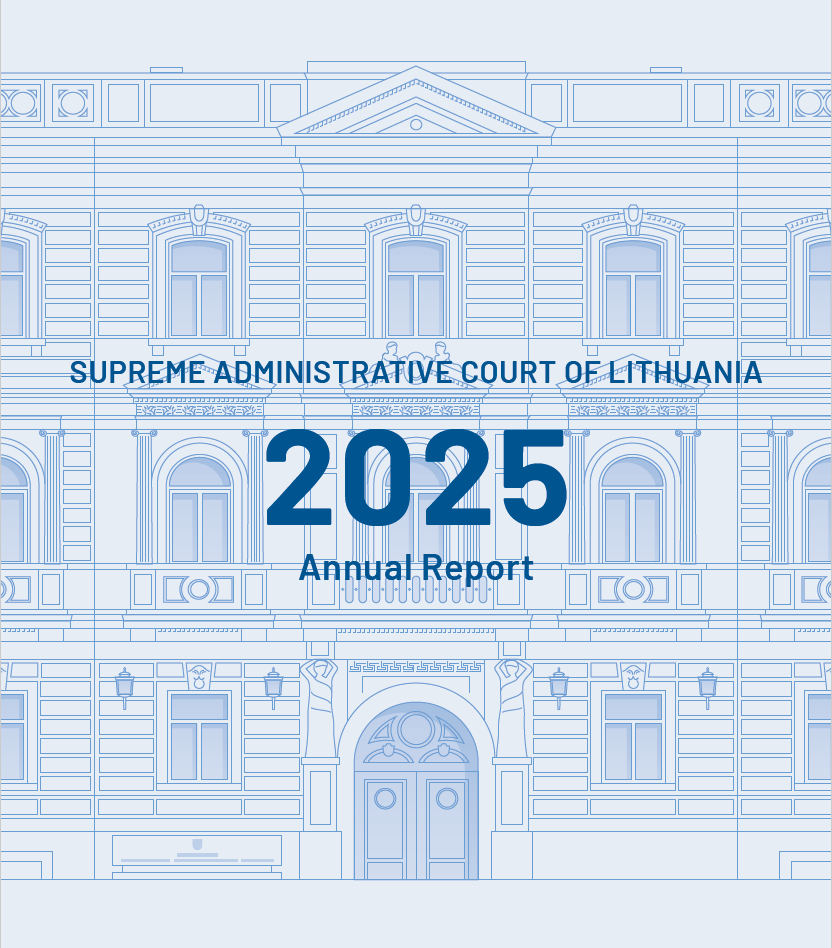
On 24 March 2025, the Supreme Administrative Court of Lithuania (SACL) presented the 2024 Activity Review to the representatives of the courts, state institutions, academia and the public. The theme of this year's event - "Court Activism in Ensuring the Protection of Human Rights in Contemporary Administrative Justice" - reflects the growing importance of the role of the courts in protecting individual rights in a rapidly changing legal environment.
The event was addressed by the Minister of Justice Rimantas Mockus and the Chairman of the Law and Order Committee of the Seimas of the Republic of Lithuania Julius Sabatauskas.
Minister of Justice Rimantas Mockus emphasised the role of administrative courts in protecting human rights and strengthening the legitimacy of public administration. He stressed the active role of the courts as a prerequisite for real protection of rights, especially in the absence of clear legal regulation.
"It is important that the courts actively take the side of human rights where the legislator sometimes lacks political will or consensus," the Minister said.
He also highlighted the Government's ambition to strengthen the independence of the judiciary, to improve its funding and to promote pre-trial dispute resolution.
According to Julius Sabatauskas, Chairman of the Law and Order Committee of the Seimas of the Republic of Lithuania, administrative courts play a crucial role in ensuring that everyone can find justice here in Lithuania without having to go to international courts. "This is the main purpose of administrative justice - to effectively protect human rights and fulfil human expectations", said Mr Sabatauskas.
The most important trends in the jurisprudence of the Supreme Administrative Court in 2024
The President of the Supreme Administrative Court, presenting the results of last year's activities, stressed that 2024 was an intensive year, both in terms of the volume of cases and their diversity. The jurisprudence of the Supreme Administrative Court of Lithuania remained diverse and constantly adapting to new challenges.
The Court dealt with administrative disputes relating to fundamental rights issues of importance to members of the public and businesses alike. The cases dealt with have covered social security, taxation, competition, education and the legal status of foreigners. In addition, cases related to financial law, protection of personal data and the civil service.
Migration law disputes related to national security threats have become one of the most important trends in the jurisprudence of the Supreme Administrative Court. 40% of all cases dealt with the legal situation of foreigners, whose number is constantly increasing due to geopolitical circumstances. The Court has handed down significant decisions interpreting the legal status of aliens and assessing in which cases the interest of national security may lead to the withdrawal of a residence permit. There has also been a significant increase in electoral disputes, which have doubled in number compared to the previous year. The Court heard important cases on the transparency of the electoral process, the content of candidates' programmes and the protection of voters' rights.
The CJEU actively cooperated with the Court of Justice of the European Union by filing five new references for preliminary rulings in 2024, bringing the total number of references since 2005 to 50. The Court has also addressed the Constitutional Court of the Republic of Lithuania on six occasions to ensure the compatibility of legal acts with the Constitution and the harmony of the legal system.
Discussion on the Court's activism in the field of human rights protection
The second part of the event included a discussion on the role of judicial activism in the protection of human rights. The discussion was moderated by Prof. Toma Birmontienė, PhD, and the insights were shared by Stasys Šedbaras, Associate Judge of the Constitutional Court of the Republic of Lithuania, Chairman of the Lithuanian Bar Council Mindaugas Kukaitis, Prof. Eglė Bilevičiūtė, legal scholar and member of the Administrative Disputes Commission of the Republic of Lithuania, Egidijus Šileikis, Judge of the Supreme Administrative Court of Lithuania, Prof. Egidijus Šileikis, PhD, as well as the Dean of the Faculty of Law of Vilnius University, Prof. Haroldas Šinkūnas, PhD, Associate Professor of the Law.
The participants discussed the concept of judicial activism, its significance in the context of administrative justice, its advantages and disadvantages, and the prospects for the development of pre-trial administrative litigation.
Dr. Stasys Šedbaras, Associate Judge of the Constitutional Court of the Republic of Lithuania, stressed that administrative courts play a unique role in protecting human rights in relation to the state - the speedy resolution of a case is not only a legal but also a social value. Therefore, the administrative justice system must be consistently strengthened, and the court's proactivity, taking into account the interests of the parties to disputes, must remain an integral part of its mission.
Mindaugas Kukaitis, Chairman of the Bar Council, presented the results of a regular survey reflecting the public's trust in the courts, the effectiveness of human rights protection and the guarantee of equality before the law. He raised the question of whether judicial activism can become a symbol of trust and be identified with justice. Discussing the challenges observed in the practice of lawyers regarding the admissibility of complaints and the reimbursement of costs, the President stressed that these insights were not a criticism, but a call for improvement, in order to ensure that people do not lose confidence in the legal system and in the State.
Dr Haroldas Šinkūnas, Associate Dean of the Faculty of Law of Vilnius University, called for a critical assessment of the limits of judicial activism, stressing that its implementation requires a very responsible approach. Associate Professor Haroldas Šinkūnas drew attention to the challenges of judicial activism posed by judges and legal scholars. He stressed that the active role of the judge must be responsibly balanced and the uniformity of case law must be maintained in order to avoid creating situations of legal uncertainty.
Prof. Dr. Eglė Bilevičiūtė, Member of the Administrative Disputes Commission of the Republic of Lithuania, stressed the role of the Commission in promoting procedural activism, especially at the stage of the adoption of appeals. She highlighted the importance of mediation in the pre-trial phase of dispute resolution, emphasising its potential to resolve disputes more efficiently and constructively before they reach the court. According to Prof. Dr. Eglė Bilevičiūtė, independent quasi-judicial institutions such as the Lithuanian Administrative Disputes Commission and the Tax Disputes Commission already have sufficient capacity to take on a larger workload of dispute resolution. She highlighted the possibility of making the settlement of service disputes compulsory, as well as the handling of damages and litigation costs, thus contributing to a more efficient administrative dispute resolution process.
In his presentation of the concept of judicial activism, Prof. Egidijus Šileikis, Judge of the Supreme Administrative Court, emphasised its multidimensional nature, ranging from linguistic and legal interpretation activism to supranational, constitutional and human rights and freedoms activism. He pointed out that there is no unanimity in legal doctrine on how to define judicial activism, and this debate only reaffirms this. According to the judge, it is important not to view judicial activism as a clear evil or as an absolute value, but to seek a balance.
The Supreme Administrative Court will continue to strive to ensure effective protection of human rights
Concluding the event, the President of the Supreme Administrative Court stressed that the courts must not only ensure that legality is upheld, but also that human rights are actively protected. "An activist court is a court that is able to react promptly to new legal challenges, boldly applies and interprets legal norms, ensuring that the implementation of the principle of justice keeps pace with the changing realities of society. The effectiveness of administrative justice depends on its ability to adapt to changing social and legal circumstances, while maintaining the right balance between legal stability and a flexible approach to new challenges", she said.


Contacts
Žygimantų st. 2,
LT-01102 Vilnius Lithuania
Phone: +370 5 279 1005
Mobile: +370 655 22502
E-mail: info@lvat.lt
Working hours
I-IV 8.00 – 17.00
V 8.00 – 15.45
Lunch break 12.00 – 12.45
Hours for receiving complaints and requests at the office:
I-IV 8.00 – 17:00
V 8:00 – 15:45
Additional hours for pre-registered persons for receiving complaints and requests at the office:
I 17.00 – 17:30
III 17.00 – 17:30
Contacts
Supreme Administrative Court of Lithuania
Žygimantų st. 2,
LT-01102 Vilnius Lithuania
Phone: +370 5 279 1005
E-mail: info@lvat.lt
Code 188734870
Working hours
I-IV 8.00 – 17.00
V 8.00 – 15.45
Lunch break 12.00 – 12.45
Hours for receiving complaints and requests at the office:
I-IV 8:00 – 17:00
V 8:00 – 15:45
Additional hours for pre-registered persons for receiving complaints and requests at the office:
I 17.00 – 17:30
III 17.00 – 17:30
Publications

Maps of courts

