


News
The rule of law in times of challenge – insights from European judges in Vilnius
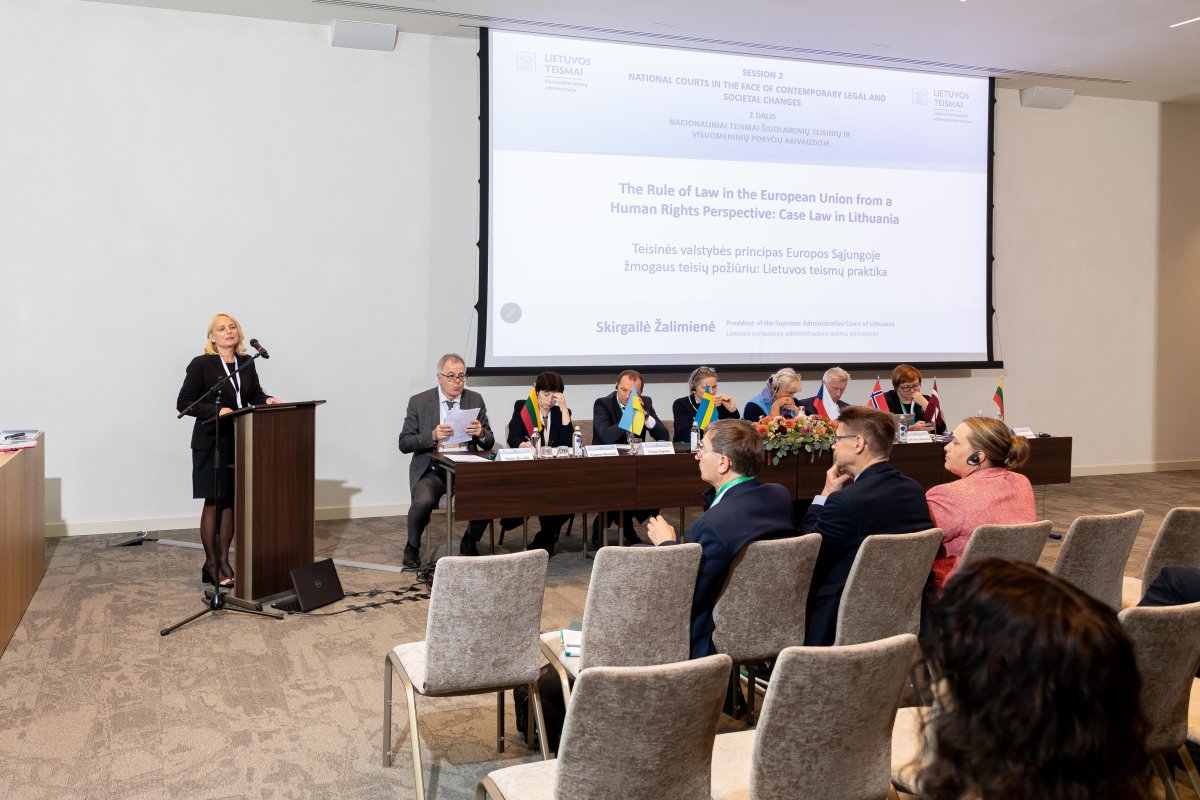
War, geopolitical tensions, migration, disinformation and threats to national security are changing the circumstances in which states are required to make decisions, but they do not remove the obligation to respect human rights and act within the limits established by law. This was one of the central themes of the international conference “The Role of Courts in Strengthening Democracy and the Rule of Law in Times of Challenges”, held in Vilnius on 24 September.
The event, organised by the Supreme Administrative Court of Lithuania (SACL) and the National Courts Administration (NCA), brought together judges of the European Court of Human Rights (ECtHR) and the Court of Justice of the European Union (CJEU), presidents of European supreme administrative courts, national judges and legal experts.
The discussions explored what protecting the rule of law means in practice when national security interests and human rights come into conflict, how the functioning of courts can be ensured in wartime, why judicial independence is inseparable from public trust, and what role dialogue between national and European courts plays within the common European legal space.
The conference was opened with welcoming remarks by Tomas Davulis, President of the Constitutional Court of the Republic of Lithuania; Rita Tamašunienė, Minister of Justice of the Republic of Lithuania; Atle Konta Midttun, Ambassador of the Kingdom of Norway; Skirgailė Žalimienė, President of the Supreme Administrative Court of Lithuania; and Danguolė Bublienė, President of the Judicial Council and President of the Supreme Court of Lithuania.
Opening the conference, President of the SACL Skirgailė Žalimienė stressed that democracy and the rule of law cannot be taken for granted – they require continuous protection and reinforcement.
“Courts cannot eliminate every threat facing democracy. They can, however, ensure that public authorities act within the limits established by law, that human rights are effectively protected, and that no individual or institution is above the law,” said Skirgailė Žalimienė.
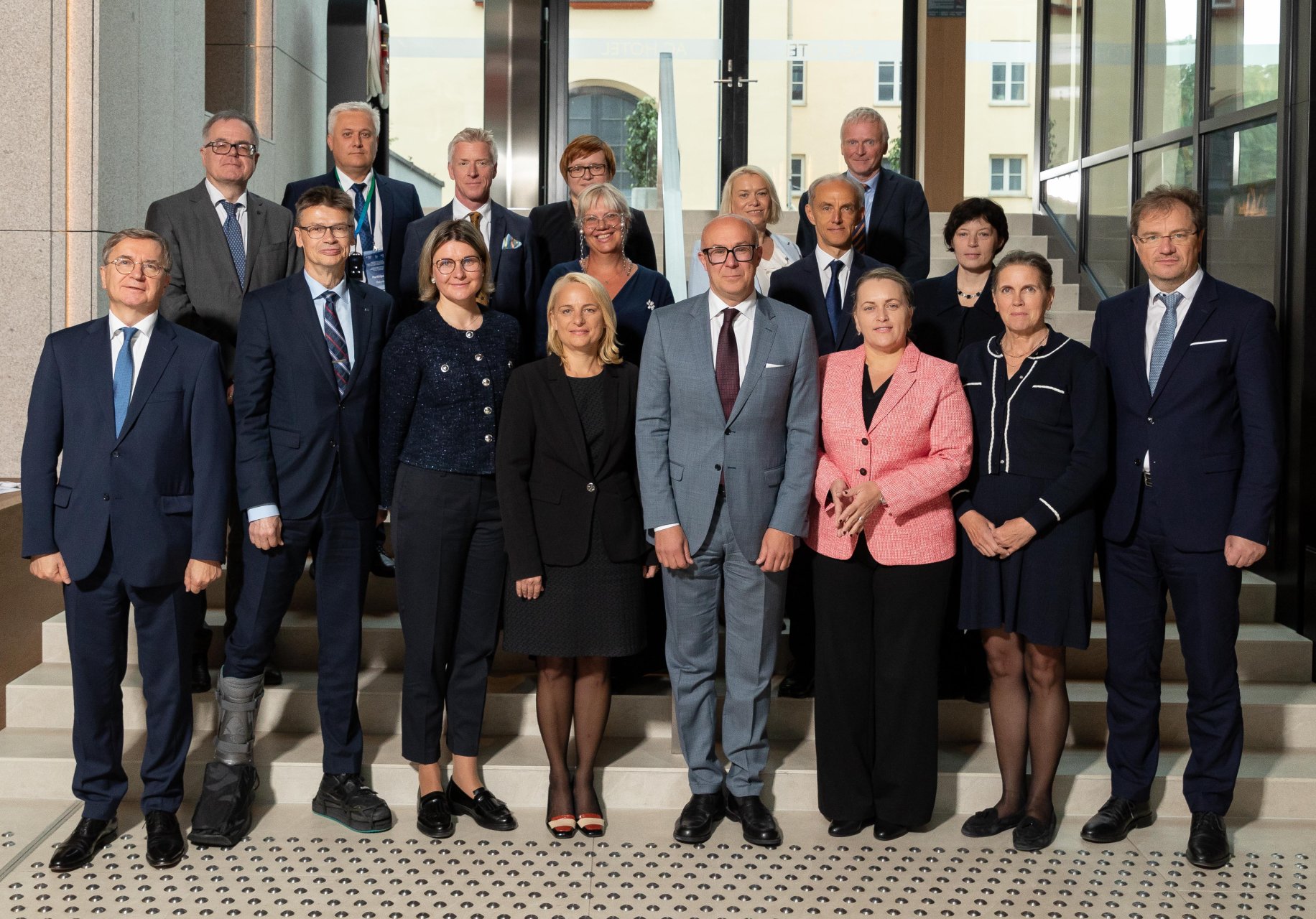
Dialogue between European courts strengthens the protection of fundamental rights
An important part of the conference was devoted to the standards of judicial independence, fundamental rights and the rule of law developed by European courts.
Ivana Jelić, Vice-President of the European Court of Human Rights, examined judicial independence as one of the fundamental conditions of the rule of law and discussed the contemporary challenges facing this principle. At the conference, judicial independence was considered both as a safeguard protecting the judiciary itself and as an essential condition for the effective protection of human rights.
Before an independent court, individuals must be able to challenge decisions of public authorities and expect their cases to be examined impartially, irrespective of political, public or other forms of pressure.
Irmantas Jarukaitis, Judge at the Court of Justice of the European Union, addressed the protection of fundamental rights under European Union law. His presentation focused on ensuring the effectiveness of the Charter of Fundamental Rights of the European Union in the case-law of the CJEU.
The presentation highlighted the importance of dialogue between national and European courts: fundamental rights standards enshrined in European Union law are implemented by national courts when deciding individual cases, while cooperation with the CJEU helps to ensure the uniform and effective application of EU law.
Danguolė Bublienė, President of the Judicial Council and President of the Supreme Court of Lithuania, likewise emphasised that the effectiveness of European law depends on the ability of national courts to apply and interpret it in cooperation with the CJEU. According to her, such judicial dialogue strengthens not only the protection of human rights but also the European legal space itself.
Artūrs Kučs, Judge at the European Court of Human Rights, examined another challenge facing contemporary democracies – the protection of freedom of expression, freedom of assembly and free elections in an age of disinformation and conflict. He drew attention to cyberattacks and disinformation campaigns aimed at influencing public debate and undermining trust in democratic institutions, including courts.
The conference thus highlighted two closely interconnected perspectives on the protection of fundamental rights in Europe: that of the European Convention on Human Rights, presented by Ivana Jelić and Artūrs Kučs, and that of European Union law, discussed by Irmantas Jarukaitis. Both perspectives were linked by a question of fundamental importance to national courts: how to ensure that the standards of the rule of law and fundamental rights operate not merely at the level of principles but also provide effective protection of human rights in individual cases.
The discussion on strengthening the rule of law in Europe was further enriched by Kari Kuusiniemi, President of the Supreme Administrative Court of Finland and Vice-President of the Board of ACA-Europe, who discussed the importance of cooperation among supreme administrative courts in strengthening the rule of law, and Jacek Chlebny, President of the Supreme Administrative Court of Poland, who presented the experience of Polish administrative courts in migration and refugee cases.
The insights from the first part of the conference were summarised by Vygantė Milašiūtė, Associate Professor at the Faculty of Law of Vilnius University.
Security and human rights are not an “either-or” choice
One of the most prominent topics discussed at the conference was the role of courts in cases where national security interests come into conflict with individual rights.
Anita Kovaļevska, President of the Department of Administrative Cases of the Senate of the Supreme Court of the Republic of Latvia, presented the experience of Latvian courts in assessing restrictions on human rights in the context of geopolitical threats. She emphasised that geopolitical threats do not, in themselves, alter the methodology of applying the law: courts must continue to balance competing constitutional values and assess, in each individual case, whether restrictions on human rights are justified and proportionate.
General threats must therefore be assessed in the light of the circumstances of the individual concerned.
Lithuania’s experience in this area was presented by Skirgailė Žalimienė, President of the Supreme Administrative Court of Lithuania. Her presentation examined the principle of the rule of law in the European Union from the perspective of human rights protection and discussed relevant Lithuanian case-law.
Administration of justice in Ukraine during wartime
The experience of Ukrainian judges was of particular significance at the conference. Sergiy Chyrkin, Judge at the Administrative Cassation Court within the Supreme Court of Ukraine, spoke about the functioning of Ukraine’s judicial system during the war – in circumstances where institutions must reconcile, on a daily basis, the needs of national security, the protection of human rights and the continuity of the administration of justice.
Sergiy Chyrkin emphasised the shared understanding between Lithuanian and Ukrainian courts that an independent judiciary is a fundamental guarantee of democracy. In his view, during wartime Ukraine’s administrative courts face daily challenges that test the State’s ability to remain governed by the rule of law.
The experiences of different national courts also revealed other dimensions of the rule of law. Linda Haggren, President of the Supreme Administrative Court of Sweden, spoke about the role of a supreme administrative court in creating precedents and providing guidance on the application of the law. Such judgments extend beyond the individual dispute: they help individuals, businesses and public-sector institutions better understand how the law should be applied in comparable circumstances and thereby contribute to legal certainty.
Barbara Pořízková, Vice-President of the Supreme Administrative Court of the Czech Republic, examined the role of the President and the limits of presidential powers under the rule of law, while Leif Otto Østerbø, Director of the Norwegian Courts Administration, focused on judicial independence and accountability as two pillars of public trust in the courts.
Judicial independence and accountability strengthen public trust in the courts
Judicial independence was also the central theme of the panel discussion that concluded the conference.
The discussion, “Ensuring Judicial Independence in a Changing World” brought together Liudmyla Yeresko, Judge at the Administrative Cassation Court within the Supreme Court of Ukraine; Torstein Frantzen, Judge at the Norwegian Court of Appeal; Gabrielė Juodkaitė-Granskienė, Judge at the Supreme Court of Lithuania; Milda Treigė, Director of the Permanent Office of the European Network of Councils for the Judiciary; Vigita Vėbraitė, Dean of the Faculty of Law of Vilnius University; and Ernestas Spruogis, Vice-President of the Supreme Administrative Court of Lithuania. The discussion was moderated by Darius Žeruolis.
Throughout the conference, judicial independence was addressed as an essential condition for the proper administration of justice, inseparable from accountability, transparency and public trust. Milda Treigė pointed out that judicial independence depends not only on formal safeguards but also on how those safeguards operate in practice – including court governance, allocation of cases, workload, the reasoning of judgments and the ability to withstand external pressure.
According to Jurga Greičienė, Director of the National Courts Administration, this is precisely why international professional dialogue is important not only for judges but also for institutions supporting judicial self-governance.
“Judicial systems in different countries operate under different circumstances, yet they are facing an increasing number of common challenges – from judicial independence and public trust to the ability to ensure effective justice in times of crisis. International dialogue enables us to exchange good practices on how institutions supporting judicial self-governance can contribute to creating the conditions necessary for courts that are independent, accountable, resilient in the face of challenges and trusted by society,” said Jurga Greičienė, Director of the National Courts Administration.
The experiences presented at the conference demonstrated that European courts face a wide range of challenges – from administering justice during wartime in Ukraine to migration, disinformation, national security and questions of public trust in other countries. Yet the same principle of the rule of law applies in all these circumstances: difficult conditions do not, in themselves, remove the obligation to comply with the law. Decisions taken by public authorities must remain subject to judicial review, restrictions on human rights must be justified and proportionate, and judges must have a genuine ability to make decisions independently.
The international conference “The Role of Courts in Strengthening Democracy and the Rule of Law in Times of Challenges” was organised by the Supreme Administrative Court of Lithuania and the National Courts Administration. The event was financed by the Bilateral Cooperation Fund of the Norwegian Financial Mechanism 2021–2028.


Contacts
Žygimantų st. 2,
LT-01102 Vilnius Lithuania
Phone: +370 5 279 1005
Mobile: +370 655 22502
E-mail: info@lvat.lt
Working hours
I-IV 8.00 – 17.00
V 8.00 – 15.45
Lunch break 12.00 – 12.45
Hours for receiving complaints and requests at the office:
I-IV 8.00 – 17:00
V 8:00 – 15:45
Additional hours for pre-registered persons for receiving complaints and requests at the office:
I 17.00 – 17:30
III 17.00 – 17:30
Contacts
Supreme Administrative Court of Lithuania
Žygimantų st. 2,
LT-01102 Vilnius Lithuania
Phone: +370 5 279 1005
E-mail: info@lvat.lt
Code 188734870
Working hours
I-IV 8.00 – 17.00
V 8.00 – 15.45
Lunch break 12.00 – 12.45
Hours for receiving complaints and requests at the office:
I-IV 8:00 – 17:00
V 8:00 – 15:45
Additional hours for pre-registered persons for receiving complaints and requests at the office:
I 17.00 – 17:30
III 17.00 – 17:30
Publications

Maps of courts

